Showing posts with label collaboration. Show all posts

Tuesday, June 6, 2023

Suggestions for Sharing Your Learning with Staff: Collaboration and Communication

             As teachers, it is so easy to become fixed in our ways and routines. We have so much to juggle each year that it is easy to do the same thing the same way each year simply to take a few things off our minds. This is nothing new. I remember being in elementary school and always checking out the art bulletin boards of each teacher in the hallways because I knew with absolute confidence that I would get to do those exact art projects when I was in that classroom in following years (because they were the same every single year). And I did.

I get it- it is WAY easier for teachers to always do the familiar things since there are a million other things to keep track of and think about. But, we also know that it isn't always what is best for students. Despite this, I’ve noticed that teachers have a tendency to resist change and new things. So, the delicate job of a TL is to support teachers in this area and help them find ways to incorporate new things into their practice without scaring them off.                      A part of this is understanding that the biggest hurdle for a TL in supporting teachers in new things or collaborations might be that teachers are worried that a new addition to their practice is going to cause them more work (Husid, 44). And for whatever reason, I’ve noticed that this hesitancy is somehow made even worse when the new thing involves technology! However, this hesitancy doesn’t always mean that staff are unwilling, just that they don’t want you to create extra work for them - so know that they are just going to need some extra support.

To that end, while I’m not in a TL position, here are the ways that I see staff at my school needing to be supported in order to try the new technologies and ideas that we are meant to curate as teacher librarians:


  1. Ask for staff input (Husid, 44)

In order to be successful in any collaborative venture with staff, you need to know what they want and need (Husid, 44).

What are the primary areas that your staff want to be supported in? What do they expect that support to look like? 
Source

If staff aren't sure what they want or don't know what you can offer, you could even consider putting out a list of skills that you want or are able to support staff in and have them rank them in their order of interest for each skill
My personal favourite way to gather staff info like this has been through google forms. It is an easy way to gather information from staff (just send a link through email) and then wait for the info to come flowing in.

        If you find that this isn’t getting the staff response you’re looking for, consider that you can even incentivize the survey. Much like how Fullner suggests we can incentivize things for volunteers in the library, be aware that you may occasionally want to incentivize things for staff when you’re just starting out (39).

For example, try letting staff know that those who complete the survey will be placed into a draw for a prize at the end of the time period you want the information for. A five dollar chocolate bar or coffee gift card for a latte is going to be SO worth it if it gives you increased staff input on their wants and needs.

Source


Once you have staff input, get to work on analyzing your results. If lots of staff want support in digital literacy, or research skills, or with a specific program- move forward making a plan on how you can provide that (Husid, 44). Find commonalities in the responses where you can and consider catering to broader areas of need so that you will be able to reach more staff with less initial work on your part.

  1.  Know Your Staff (Husid, 44)

When I think of the staff at my school, I have a good idea of those who are going to be more open to new ideas and suggestions vs those who are going to take a while to warm up to anything new. Start with the staff who are going to be “easier” (Husid, 43-44). Let them experience your new things and how great (and easy) collaborating with you on a new thing can be.
At some point, they’re inevitably going to mention the great new thing you did with their class to someone else, or you’ll put up a display in the hall showing that great new work and others will get curious (Burns, 11). 

The saying is, you can lead a horse to water, but you can’t make it drink… it's sort of the same with staff… you can lead them to new ideas, but you’re not going to force any of them to use them, at least, not effectively. 

  1. Understand that you may carry the majority of the workload to start

Some (many?) staff need to be FULLY supported at the beginning of anything new to be successful. We are talking full-on support where they basically just show up and watch you do the new thing with their students (Husid, 44). We can call this collaboration if you’d like, but honestly, at the beginning it's kind of a sales pitch. 

We need to “sell” the features of the new program/idea/thing and show teachers how it works while they get to stand back and basically see what they think.
Thankfully, this stage shouldn’t last forever. As teachers see how your program supports what they indicated they wanted to work on in your staff data-collection phase, there’s an amount of buy-in that will get them wanting to ask questions and be involved (Husid, 44). There is then the opportunity to scaffold in gradual release of responsibility for that teacher- just like we do with students (I do, we do, you do) (Heick). These stages might go quickly, or they might take a while. Just like our students, not all teachers are going to move through the release of responsibility at the same pace. For some teachers, you may be in that “we do” stage of togetherness for a while- so be prepared to support for the long haul

Source

  1. Provide professional development opportunities (outside of your collaboration slots) (Burns, 10).

    Source

This is a great way to gather interest for future collaborations, teach staff those specific skills they are asking for, reach a broader crowd of staff and assert your ability to work as a leader within your school (Burns, 10). 


Ways that I’ve supported staff in professional development in the past (as just a classroom teacher) have been through:

  1. Learning Lunches

 Learning lunches are great because they’re bite sized pro-d, they don’t eat too much into anyone’s personal time (since teachers are going to be at school during lunch anyways), and you can offer multiple sessions to cater to different levels of teacher need.
One example of me using a learning lunch as a pro-d for staff was setting up and leading a learning lunch on using and creating google forms.
Our teaching staff was gearing up for parent-teacher conferences and reached out saying that they wanted an easy way to send out their conference info to families that allowed them to organize a schedule. I was able to offer a learning lunch specifically focused on creating a google form that they could send to families for their parent-teacher conferencing.
Understanding that collaboration works best when we are prepared, I had a template ready, shared it out with teachers, and then invited any teachers who needed help using the features of google forms to edit that template for their needs to a learning lunch (Husid, 44). This worked twofold in that it let me know who was able to use the template without my help, and it let me really focus in my support on those who needed it. 

Once everyone arrived to the learning lunch, I was able to walk everyone through the process step-by-step, and all the teachers left with a survey they could send out (and knew how to send out). I encouraged anyone who needed further support with this to reach out to me. It worked out great and my impression was that people left feeling pretty satisfied! I did troubleshoot with a few people thereafter who reached out, and that was great too.

  1. Staff meeting presentations

This one is a bit trickier, since not everyone is necessarily going to be interested and on board immediately. If you’re going to present to staff to get everyone on board with a new program or idea, the best way might be to show them a tangible example of what you are talking about and can do if possible, or a concrete plan of action and support. This might mean piloting it with a teacher individually first so that you have some tangible evidence to show at the staff meeting (Husid, 44). They say actions speak louder than words, and for teachers, seeing a program in action or seeing tangible artifacts of work is going to make all the difference (Husid, 44). That way, you’re not just all talk. 

  1. Videos on using new tech
    This is something that can be both a huge time saver for you, and a huge convenience for teachers. Putting together small how-to guides on FAQ for tech especially can be massively useful. I know our district has put out guides on how to use things like MyEd reporting and I use them EVERY term. And not even all of these are videos, some are just documents with great pictures laying out how to do things.
    If you notice people are repeatedly approaching you to ask the same question about a specific thing or program, that is a good indication that it is a great time to make a video and store it on an accessible space (like on a document in a staff google drive). That way, people can simply access the information that they’re looking for at any time.
    Similarly, I know that we have schools in our district that have implemented this not just as staff professional development, but as learning opportunities for students. Students work with library staff to make “tech-check” videos that remind other students (and staff?!) how to care for technology around their school that can be accessed through the school website. They cover things like how to properly plug in an ipad, how to turn iPads off, etc. A great twist on professional development! Here is episode one, on plugging in an iPad! (I tried to add it in as a direct video, but the file is too large unfortunately!).


  1. School wide projects and initiatives
    I think that this can be great for either growing interest in a topic that staff are not aware of, or for celebrating growth of learning throughout the year- or both (do one in first term and one in June on the same topic)!  It also has the potential to revitalize projects that have perhaps lost momentum or steam as the year progresses.
    For this, I think the most important piece is recognizing again that staff aren’t going to participate in these if you make it added-work for them- so make it easy.
    For example, send out a package of activities for primary and intermediate teachers, during student library time pick books or teach mini lessons related to your topic, and/or have fun challenges that acknowledge teachers and students’ fun competitive spirits or prizes that assist you with buy-in. 
    Basically, be ready to take this on as your baby, since it is likely that in order for it to run successfully, you will need to do all (or a lot of) the legwork to make it fun and engaging for everyone
    Of course, you should also always ask for teacher input on how they think it can or should be done, and work with teachers to make those ideas possibilities (even better if  they are keen to support), but understand that it might also be a bit of a one-man show situation depending on what your staff are like!


Whew! Okay, that is a lot of thoughts on how to bring things to staff (sorry!!). But I think that is because there are so many different ways to bring new things to staff to motivate them to engage with material and use it- and it just isn't a one size fits all situation for introducing all things.

If you have amazing ideas, but no one is going to use them, it really doesn’t do anyone any good. So I would say more than half the battle is figuring out how your staff responds to you presenting new things and capitalizing on the ways that incite excitement and interest in your staff vs inaction and indifference. 

Ideas only work if people ultimately want to work on them with you 🙂 

Source


I hope when I am in a TL position one day that I will be able to curate positive relationships with staff, meet their needs, and find ways to share innovations with them through these strategies (and more as a I learn along the way). 


Works Cited


Burns, E. A. (2018). Advocating for Change in School Library Perceptions. Teacher Librarian,   46, 8-14 


Fullner, S. (2004). Perks, Rewards and Glory: The Care and Feeding of Volunteers. Library Media Connection, 22(4), 38-39.  

Heick, Terry. “The Gradual Release Of Responsibility Model In 6 Simple Words”. TeachThought, 28 February, 2021, www.teachthought.com/pedagogy/gradual-release-responsibility/.

Husid, W. (2013). Collaboration: Make It Happen in Your School. Library Media Connection,31(4), 42–44


NSMS Digital Literacy. “Tech Check”. School District 63, 14, February, 2023, sites.google.com/sd63.bc.ca/nsms-digitalliteracy/tech-check.

Friday, June 2, 2023

Developing Skills Through Learning From Others: How Networking Provides Opportunities for Lifelong Learning and Professional Development

With teacher librarians heralded for their skills as collaborators and team players, it makes sense to me that one of the best ways that we can continue to develop our skills and professional development opportunities comes from connecting online and in person to other educators or groups of librarians (a.k.a. Networking!). I know that some of the best ways for me to learn and grow my practice as a classroom teacher have been through connecting with others and experiencing what they are doing.  

Below is a short video on the importance of networking (as a form of professional development) and creating in person and online connections with “like hearted people” which I will discuss below through the ideas of both mentorship opportunities (formal and informal) and a variety of online platforms (KnowledgeWave, 00:55-01:25). 


In order to further my own skills as a teacher librarian, I would look to connect with librarians in my district or even my community as suggested in the video above (KnowledgeWave, 01:20).

Source

    Ideally, this would be either through an opportunity like a mentorship program or a district library association that provides an informal mentorship-like program which is supportive of newer librarians (Freedman, 16; KnowledgeWave, 00:56-01:19).  A study established that librarians who entered into a mentorship (formal or informal) found that the benefits that they reaped were “increased self-confidence…, improved professional growth and development, improved learning, career development and satisfaction and cultivation of personal as well as professional growth.” (Freedman, 5). All good things! 

These benefits were a result of what Freedman called “mentoring activities” which included “sharing knowledge, insight, and experience, providing psychosocial support, guiding, role modeling, providing ideas and networking opportunities.” (5). So, it was demonstrated that the opportunity to have an experienced librarian to connect with for guidance via regular interactions, library visits, and information sharing opportunities, and more has a “powerful” impact and can contribute to the "success of …[the] library” (Freedman, 18). Understanding this, I would be remiss to ignore or pass up any opportunities our district has for connecting with other library staff in mentorship capacities!


Additionally, despite not being in a TL role at the moment, I am also actively working to connect with a broader group of librarians and educators through online platforms. These connections work as a much more informal "mentorship" opportunities where I can look to see what others are doing in different capacities, but also contribute if I am able.

Online communities that I have either joined, followed, or interacted with include: Future Ready Librarians Facebook Group (on Facebook); Centre For Global Education (on instagram); TLChat, ISTEOfficial, and SchoolLibary (on twitter); and finally BlueSkunk Blog, The Daring Librarian, and Library Adventure as bloggers on various platforms (Miller and Bass, 67-68).
By joining and interacting with people on these platforms, I am creating a situation in which I am exposed to other amazing educators just by the nature of checking my own social media and blog browsing (which I do anyways). I hope to continue to grow my personal learning network (PLN) and use these exposures as opportunities to gather ideas and understandings about how I can continue to grow as both an educator and as a librarian.  

Source

To that end- let me know in the comments if you have any ideas about people or organizations who I should look into following or joining!


However, given that simply being exposed to ideas is often not enough to actually motivate us to make meaningful changes within our daily practices, I am looking to further my engagement by way of saving and documenting ideas which are particularly helpful or interesting to me through a blog or a personal journal. 

A blog or journal would provide me with an opportunity to organize and note down ideas that are meaningful and should be explored at a future time. From those notes, I could then create goals for myself to expand my understanding of these ideas and/or try these things in my practice. The blog or journal would then further provide me with an opportunity to document and reflect on my progress in each goal area.

I believe that using a blog or journal to commit to one area of professional development (or one way that I want to improve or tweak my practice) at a time is a realistic way to begin and that, depending on the scope of the item, I may need more or less time to achieve them (which is why I'm hesitant to set a number of goals to achieve per year).  However, with a plan in place to record my learning and experimentation, I will be more likely to follow through and actually use what I learn from my mentorship and PLN in meaningful ways.

In conclusion, this inquiry has reminded me that as educators, we must be lifelong learners- not just in passive ways, but in active and tangible ways. I hope that by creating these opportunities for myself, I can commit to being an active lifelong learner who will strive to innovate in the library and as an educator.

Source

Works Cited

Freedman, Shin. "Mentoring Experience of Academic Librarians: A Pilot Study of Mentorship in Academic Libraries." Library Leadership & Management (Online) 2021: 1-27. ProQuest. Web. 1 June 2023 .

KnowledgeWave. “Professional Development: Networking in the Workplace.” Youtube, uploaded by KnowledgeWave, 4 December, 2020, https://www.youtube.com/watch?v=EGVxdv066n0 .


Miller, S., & Bass, W. (2019)Leading from the Library: Help your School Community Thrive in the Digital Age. International Society for Technology in Education.

Tuesday, April 4, 2023

Flying Penguins and Re-Thinking Our Reference Collection for Digital Literacy Skills

         Throughout this theme, we have discussed a wide variety of reference resources that might be used to support student and staff learning and teaching experiences. What continued to strike me throughout our weekly lessons and my group’s weekly discussions is how deeply our student and staff needs impact the way that we build our reference collection and in the way that it is used (Lesson 8-12 Discussion Posts; Oxley). Leading Learning states that it is our role as Teacher Librarians to “develop and support excellent school libraries responsive to the diverse needs of learners today and into the future” and that this comes from “provid[ing] access to teaching expertise in the library as well as best resources, technologies and physical and virtual learning spaces to support learner needs as they evolve” (Canadian Library Association, 7). 

Keeping this in mind, it was interesting to note how each person within our discussion group viewed each weekly resource as either valuable and necessary within their library space or something that was less needed for their learning community (Lesson 8-12 Discussion Posts). This varied even within schools that have students in the same age groups. 

To my mind, the largest piece from this theme that resonated as needing attention in my school’s library is access to digital resources and the digital literacy skills to utilize these resources safely, critically, and effectively. 

library.pima.gov/blogs/post/four-things-you-should-know-about-digital-literacy/
Source


The video below explains why digital literacy is so important and highlights how teachers, including teacher librarians whose goals are “[k[nowledge-building, creativity and innovation, and honing of information management and literacy skills” (Canadian Library Association, 15) should not be skipping on teaching students these skills. 


 Our library has a reasonable supply of the quality print resources discussed throughout this theme but continues to be sorely lacking in having staff and students who are confident and able to utilize the digital resources that are available to them, such as BC Digital Classroom. This is detrimental not only to students’ opportunities to engage with content (as our print resources can truly only contain so much), but detrimental to their developing skill set, as they are missing out on a larger part of what will be expected of them moving forward in life.

Leading Learning tells us that “[l]earners also need to ‘learn how to learn’ through deliberate design of opportunities to build metacognition of learning skills, process and content. It is essential to support both student and teacher growth and success in these areas” (Canadian Library Association, 15).  Currently, we have the print resources to support the learning of skills related to print resources, but do not have what is needed to engage students in these same ways with digital resources.

For that reason, my takeaway from this theme and my personal goal as a teacher librarian for my specific school would be to work with students and staff using Riedling’s general and resource specific evaluation criterions to source quality and needed resources in digital formats (18,33,43,50,58,67,82). From there, the key will be to explicitly and deliberately teach and support staff in their digital literacy skills using these resources (much as I've outlined in assignment 2) so that we can then teach and support students in that same resource use and the digital literacy opportunities that go along with using digital resources because...


“Without an excellent school library functioning as a learning commons, students are severely disadvantaged. Students need to be working with the best technologies and resource collections available. They require expert instruction and guidance to become sophisticated users of information and ideas in our complex world. To meet their learning potential and participate fully as successful learners and contributors our students need learning opportunities and new environments deliberately designed to engage and inspire” (Canadian Library Association, 7).

So, unless teacher librarians work with students and teachers to create reference collections which provide access to robust digital and print learning resources and experiences that support digital literacy skills as well as print literacy skills, we risk doing students a major disservice. This disservice can ultimately lead them down a path where notions of flying penguins become an alarmingly possible reality and crowd sourced information sites like Wikipedia are used without care or caution (Harris, 2).


Works Cited


BBC. (2013, March 31). Flying Penguins-BBC. BBC Retrieved from www.youtube.com/watch?v=9dfWzp7rYR4.


Canadian Library Association. (2014). Leading Learning:  Standards of Practice for School Library Learning Commons in Canada.llsop.canadianschoollibraries.ca/wp-content/uploads/2016/09/llsop.pdf


Harris, C. (2007). Can we make peace with Wikipedia?. School Library Journal, 53(6), 26.


"Lesson 8-12 Discussion Posts" ( 2023, Feb 23). LIBE 467, University of British Columbia. canvas.ubc.ca/groups/489591/discussion_topics 


Macfound. (2010, December 01). Rethinking Learning: The 21st Century Learner. MacArthur Foundation. Retrieved from www.youtube.com/watch?v=c0xa98cy-Rw


Oxley, Kristie. 2023, Feb. 23 "Theme Three: Reference Materials". LIBE 467, University of British Columbia. Lessons 8-12. 


Riedling, Ann, and Houston, Cynthia. (2019). Reference Skills for the School Librarian: Tools and Tips. 4th ed., Libraries Unlimited.

Friday, February 24, 2023

Finding A Balance: The Challenge of Bulking Up a Reference Collection While Respecting a Budget and Staff Needs

As with all things in life, we need balance.

        For me, theme 2 has clearly demonstrated that, in order for a library to function as we want it to, there is a need to balance collaborative services, the collection management, and the budget that sustains it all. 

As a result of this realization, and an examination of the library at the school I work at, I have realized that things here are not in balance. This is mainly because the reference collection that we have does not contain a sufficient number of “resources [that] adequately support the particular learning outcomes that teachers are addressing in the classroom” (British Columbia Ministry of Education, 72). 

Source

On the surface, this sounds like an easy enough problem to solve: Simply buy more books! However, in reality, the endeavor to restore balance in one area of a library program means maintaining and caring for the balance in all other areas and is complex!

In Evaluating, Selecting, and Managing Learning Resources: A Guide,  the British Columbia Ministry of Education notes that once we see a flaw in a collection, the next step is a “Needs Assessment” (72). During this, it is “is important to survey teachers to determine priorities in terms of pedagogy, format, and so on” (72). This brings us back to a need for collaboration before material selection and reminds us that  “the use [and selection] of reference materials should involve a collaborative effort by the classroom teacher who is the subject expert, and the teacher-librarian, the information specialist” (Oxley, Lesson 5). Without involving our subject experts, it is impossible for us to select truly meaningful resources.

With information from stakeholders considered, we can look at the next piece of the puzzle; the budget. While every librarian dreams of an unlimited budget, the reality is that this is not the case. In fact, according to the data provided in the BCTLA’s 32nd Annual Survey of Working and Learning Conditions in Public School Libraries, my school’s funding was at $2027.83 (well below the average budget of an elementary school library in B.C.) (Hufton, 6). This means that the dream of simply buying unlimited amounts of resources with abandon to suit teachers' general research needs is not on the table. Especially ones that come with a hefty price tag and an expiry date. For example, it is not realistic for our library to spend $1000 dollars (almost half our budget) on print encyclopedias that will need to be replaced either yearly or in the near future (Oxley, Lesson 6; Riedling & Houston, 24).

A solution suggested by Riedling & Houston is the option of online materials whose cost may vary, and therefore be less (24,25). This is corroborated by the quote I received from Britannica School (an online children's encyclopedia database)which stated that a year-long, whole-school subscription would cost $439(Kirkness). These resources are regularly updated; 2 years of this service would still cost less than a set of new encyclopedias; and it would leave room in the budget for the purchase of additional needed print resources.

This solution however, leads us back to assessing our clientele needs. Our school has not previously functioned as a “tech-friendly” environment, so choosing a balance between print and online resources will take some serious promotion and leadership on the part of the TL.

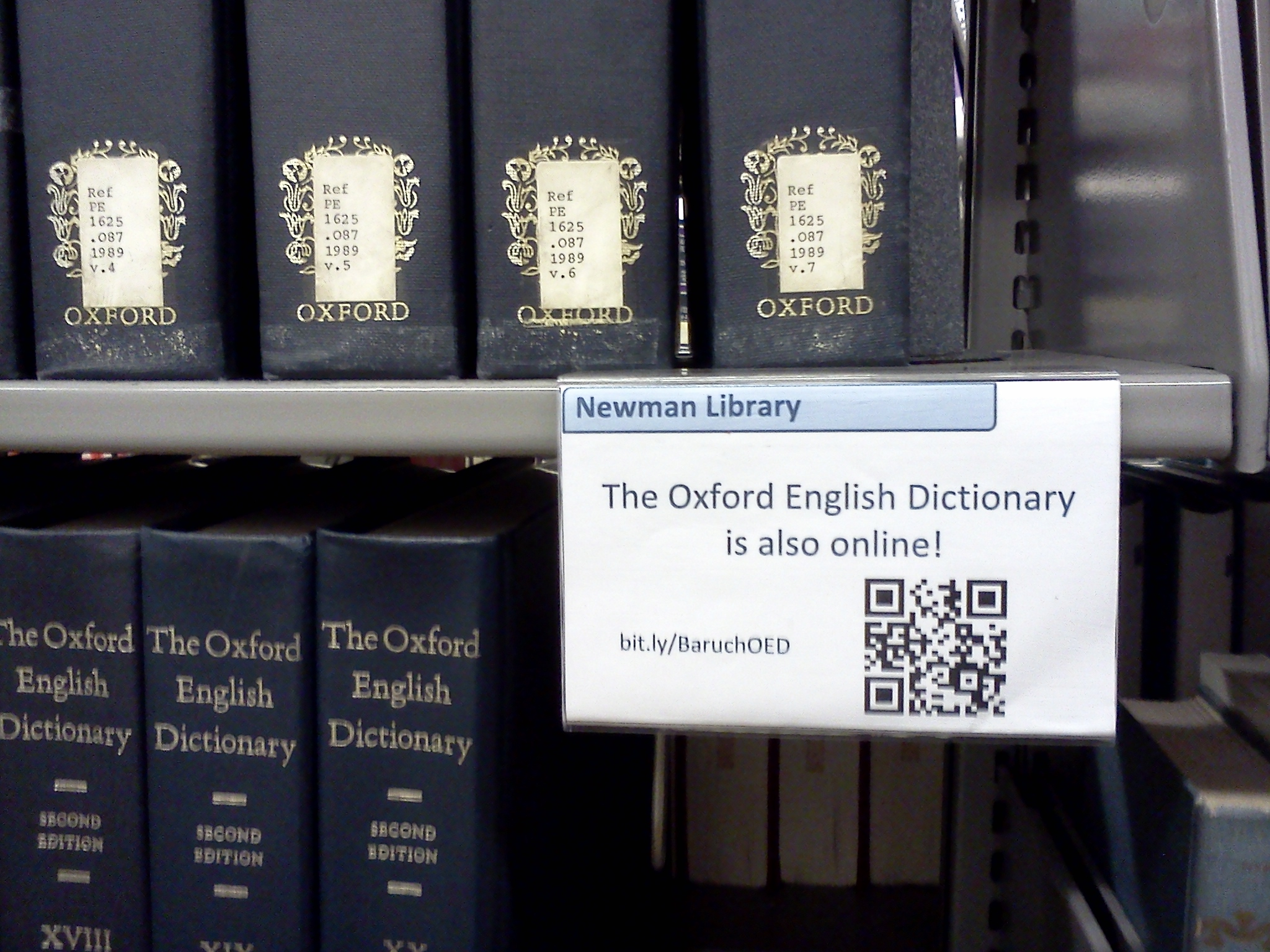
The British Columbia Ministry of Education notes that, in the promotion of new resources,  “it is vital that key personnel promote the availability, location, and curricular relevance of the resources'' (97). This might look like providing in-services on using the online database, creating bibliographies organized by curricular topics, or even putting in place a new QR code system (using a free QR code generator such as this one) that makes the resource easily accessible and joins the physical library resources with the online resources available (British Columbia Ministry of Education, 97). This is quite the undertaking for the TL, but perhaps worth it if it provides meaningful services to students and teachers.

At this point, I should note that the idea of QR codes in libraries to connect physical and digital references is not unheard of- it came up both in our group discussion in week 7 and is again explained in this video from Harvard Music Library below.


Source

With the solution of an increased reference collection through a digital resource supplemented by print resources through leftover budgets, and much teacher collaboration needed to get it all up and running... My takeaway from this theme is that striving for the balance that is needed in order to run the library effectively requires creativity, flexibility, and an ongoing willingness to work hard to provide the best information services possible for students and staff. Riedling & Houston say, "a good reference source is one that serves to answer a question" (17), so if this creative combination and use of resources maintains the balance between collaboration, budget, and question answering, it is a win for everyone.  

Source


Works Cited


British Columbia Ministry of Education. Evaluating, Selecting, and Managing Learning Resources: A Guide. Canadian Cataloguing in Publication Data, Revised 2002.


Hufton, Amanda. Annual Survey of Working and Learning Conditions of Public School Libraries (32nd). British Columbia: BCTLA, 2012/2013. 24, February, 2023.  https://bctla.ca/wp-content/uploads/2018/02/wlc-2012-2013.pdf


Kirkness, Len. "Britannica Online - SCHOOL Edition trial Access." Received by Chelsey Fidler, 02 February 2023. Email Communication. 


"Lesson 7 Discussion Posts" 24 Feb, 2023,  https://canvas.ubc.ca/groups/489591/discussion_topics/1676400 


Oxley, Kristie. "Theme Two:Managing and Evaluating Reference Services." University of British Columbia, 9 Jan. 2023. Lessons  5-7.

"QR Codes in the Library: A Window to Online Research Services" Youtube, uploaded by Harvard University, 20 Dec. 2011, https://www.youtube.com/watch?v=40vw_p4uyts

Riedling, Ann, and Houston, Cynthia. Reference Skills for the School Librarian: Tools and Tips. 4th ed., Libraries Unlimited, 2019.


Vision of the Future: Digitally Literate Deep Cove Dolphins

Image Source Introduction/Explanation For my Vision of the Future Project, I chose to expand on what I had begun exploring in my Reading Ass...