Showing posts with label LIBE 467. Show all posts

Tuesday, April 4, 2023

Flying Penguins and Re-Thinking Our Reference Collection for Digital Literacy Skills

         Throughout this theme, we have discussed a wide variety of reference resources that might be used to support student and staff learning and teaching experiences. What continued to strike me throughout our weekly lessons and my group’s weekly discussions is how deeply our student and staff needs impact the way that we build our reference collection and in the way that it is used (Lesson 8-12 Discussion Posts; Oxley). Leading Learning states that it is our role as Teacher Librarians to “develop and support excellent school libraries responsive to the diverse needs of learners today and into the future” and that this comes from “provid[ing] access to teaching expertise in the library as well as best resources, technologies and physical and virtual learning spaces to support learner needs as they evolve” (Canadian Library Association, 7). 

Keeping this in mind, it was interesting to note how each person within our discussion group viewed each weekly resource as either valuable and necessary within their library space or something that was less needed for their learning community (Lesson 8-12 Discussion Posts). This varied even within schools that have students in the same age groups. 

To my mind, the largest piece from this theme that resonated as needing attention in my school’s library is access to digital resources and the digital literacy skills to utilize these resources safely, critically, and effectively. 

library.pima.gov/blogs/post/four-things-you-should-know-about-digital-literacy/
Source


The video below explains why digital literacy is so important and highlights how teachers, including teacher librarians whose goals are “[k[nowledge-building, creativity and innovation, and honing of information management and literacy skills” (Canadian Library Association, 15) should not be skipping on teaching students these skills. 


 Our library has a reasonable supply of the quality print resources discussed throughout this theme but continues to be sorely lacking in having staff and students who are confident and able to utilize the digital resources that are available to them, such as BC Digital Classroom. This is detrimental not only to students’ opportunities to engage with content (as our print resources can truly only contain so much), but detrimental to their developing skill set, as they are missing out on a larger part of what will be expected of them moving forward in life.

Leading Learning tells us that “[l]earners also need to ‘learn how to learn’ through deliberate design of opportunities to build metacognition of learning skills, process and content. It is essential to support both student and teacher growth and success in these areas” (Canadian Library Association, 15).  Currently, we have the print resources to support the learning of skills related to print resources, but do not have what is needed to engage students in these same ways with digital resources.

For that reason, my takeaway from this theme and my personal goal as a teacher librarian for my specific school would be to work with students and staff using Riedling’s general and resource specific evaluation criterions to source quality and needed resources in digital formats (18,33,43,50,58,67,82). From there, the key will be to explicitly and deliberately teach and support staff in their digital literacy skills using these resources (much as I've outlined in assignment 2) so that we can then teach and support students in that same resource use and the digital literacy opportunities that go along with using digital resources because...


“Without an excellent school library functioning as a learning commons, students are severely disadvantaged. Students need to be working with the best technologies and resource collections available. They require expert instruction and guidance to become sophisticated users of information and ideas in our complex world. To meet their learning potential and participate fully as successful learners and contributors our students need learning opportunities and new environments deliberately designed to engage and inspire” (Canadian Library Association, 7).

So, unless teacher librarians work with students and teachers to create reference collections which provide access to robust digital and print learning resources and experiences that support digital literacy skills as well as print literacy skills, we risk doing students a major disservice. This disservice can ultimately lead them down a path where notions of flying penguins become an alarmingly possible reality and crowd sourced information sites like Wikipedia are used without care or caution (Harris, 2).


Works Cited


BBC. (2013, March 31). Flying Penguins-BBC. BBC Retrieved from www.youtube.com/watch?v=9dfWzp7rYR4.


Canadian Library Association. (2014). Leading Learning:  Standards of Practice for School Library Learning Commons in Canada.llsop.canadianschoollibraries.ca/wp-content/uploads/2016/09/llsop.pdf


Harris, C. (2007). Can we make peace with Wikipedia?. School Library Journal, 53(6), 26.


"Lesson 8-12 Discussion Posts" ( 2023, Feb 23). LIBE 467, University of British Columbia. canvas.ubc.ca/groups/489591/discussion_topics 


Macfound. (2010, December 01). Rethinking Learning: The 21st Century Learner. MacArthur Foundation. Retrieved from www.youtube.com/watch?v=c0xa98cy-Rw


Oxley, Kristie. 2023, Feb. 23 "Theme Three: Reference Materials". LIBE 467, University of British Columbia. Lessons 8-12. 


Riedling, Ann, and Houston, Cynthia. (2019). Reference Skills for the School Librarian: Tools and Tips. 4th ed., Libraries Unlimited.

Friday, February 24, 2023

Finding A Balance: The Challenge of Bulking Up a Reference Collection While Respecting a Budget and Staff Needs

As with all things in life, we need balance.

        For me, theme 2 has clearly demonstrated that, in order for a library to function as we want it to, there is a need to balance collaborative services, the collection management, and the budget that sustains it all. 

As a result of this realization, and an examination of the library at the school I work at, I have realized that things here are not in balance. This is mainly because the reference collection that we have does not contain a sufficient number of “resources [that] adequately support the particular learning outcomes that teachers are addressing in the classroom” (British Columbia Ministry of Education, 72). 

Source

On the surface, this sounds like an easy enough problem to solve: Simply buy more books! However, in reality, the endeavor to restore balance in one area of a library program means maintaining and caring for the balance in all other areas and is complex!

In Evaluating, Selecting, and Managing Learning Resources: A Guide,  the British Columbia Ministry of Education notes that once we see a flaw in a collection, the next step is a “Needs Assessment” (72). During this, it is “is important to survey teachers to determine priorities in terms of pedagogy, format, and so on” (72). This brings us back to a need for collaboration before material selection and reminds us that  “the use [and selection] of reference materials should involve a collaborative effort by the classroom teacher who is the subject expert, and the teacher-librarian, the information specialist” (Oxley, Lesson 5). Without involving our subject experts, it is impossible for us to select truly meaningful resources.

With information from stakeholders considered, we can look at the next piece of the puzzle; the budget. While every librarian dreams of an unlimited budget, the reality is that this is not the case. In fact, according to the data provided in the BCTLA’s 32nd Annual Survey of Working and Learning Conditions in Public School Libraries, my school’s funding was at $2027.83 (well below the average budget of an elementary school library in B.C.) (Hufton, 6). This means that the dream of simply buying unlimited amounts of resources with abandon to suit teachers' general research needs is not on the table. Especially ones that come with a hefty price tag and an expiry date. For example, it is not realistic for our library to spend $1000 dollars (almost half our budget) on print encyclopedias that will need to be replaced either yearly or in the near future (Oxley, Lesson 6; Riedling & Houston, 24).

A solution suggested by Riedling & Houston is the option of online materials whose cost may vary, and therefore be less (24,25). This is corroborated by the quote I received from Britannica School (an online children's encyclopedia database)which stated that a year-long, whole-school subscription would cost $439(Kirkness). These resources are regularly updated; 2 years of this service would still cost less than a set of new encyclopedias; and it would leave room in the budget for the purchase of additional needed print resources.

This solution however, leads us back to assessing our clientele needs. Our school has not previously functioned as a “tech-friendly” environment, so choosing a balance between print and online resources will take some serious promotion and leadership on the part of the TL.

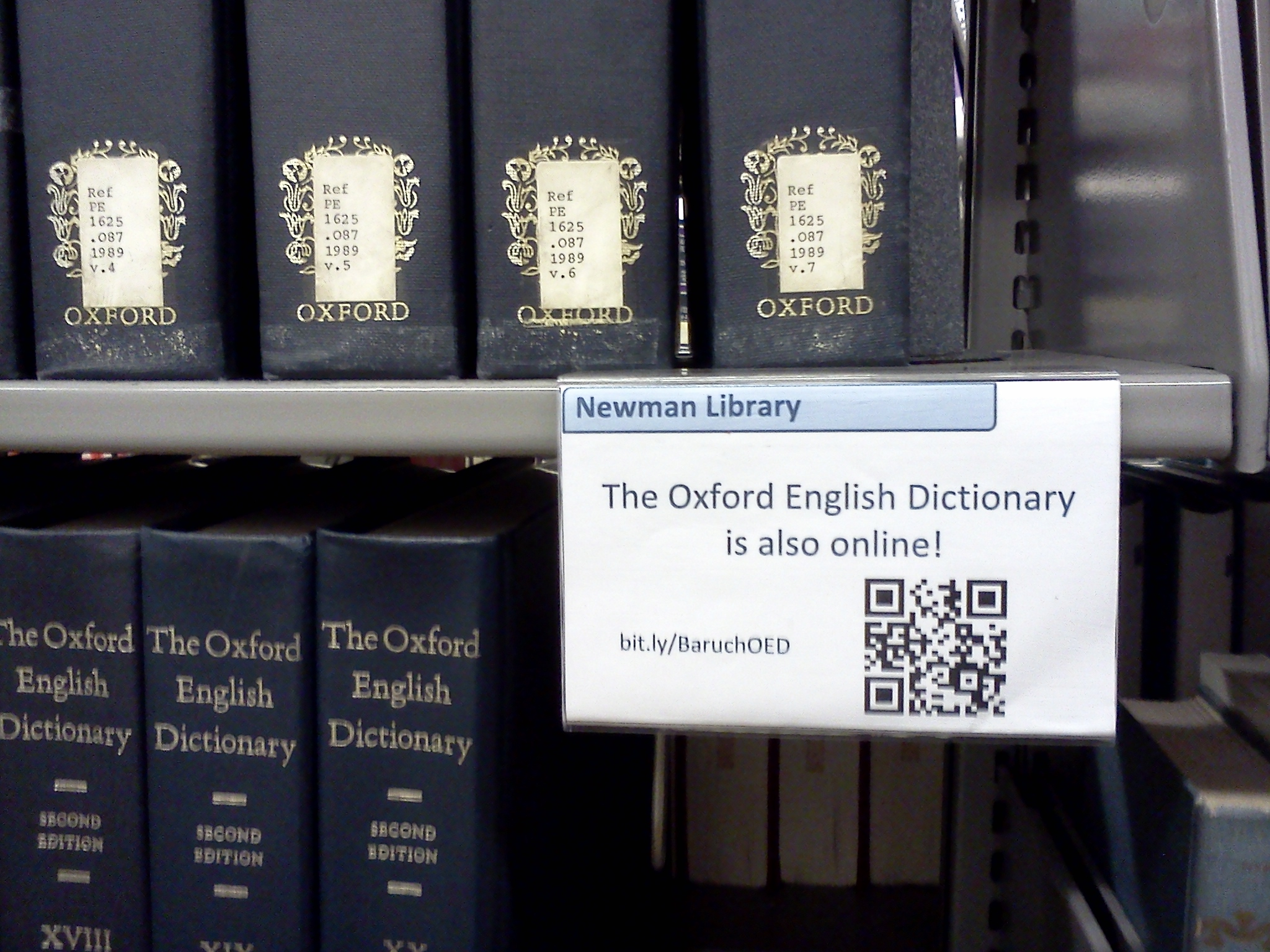
The British Columbia Ministry of Education notes that, in the promotion of new resources,  “it is vital that key personnel promote the availability, location, and curricular relevance of the resources'' (97). This might look like providing in-services on using the online database, creating bibliographies organized by curricular topics, or even putting in place a new QR code system (using a free QR code generator such as this one) that makes the resource easily accessible and joins the physical library resources with the online resources available (British Columbia Ministry of Education, 97). This is quite the undertaking for the TL, but perhaps worth it if it provides meaningful services to students and teachers.

At this point, I should note that the idea of QR codes in libraries to connect physical and digital references is not unheard of- it came up both in our group discussion in week 7 and is again explained in this video from Harvard Music Library below.


Source

With the solution of an increased reference collection through a digital resource supplemented by print resources through leftover budgets, and much teacher collaboration needed to get it all up and running... My takeaway from this theme is that striving for the balance that is needed in order to run the library effectively requires creativity, flexibility, and an ongoing willingness to work hard to provide the best information services possible for students and staff. Riedling & Houston say, "a good reference source is one that serves to answer a question" (17), so if this creative combination and use of resources maintains the balance between collaboration, budget, and question answering, it is a win for everyone.  

Source


Works Cited


British Columbia Ministry of Education. Evaluating, Selecting, and Managing Learning Resources: A Guide. Canadian Cataloguing in Publication Data, Revised 2002.


Hufton, Amanda. Annual Survey of Working and Learning Conditions of Public School Libraries (32nd). British Columbia: BCTLA, 2012/2013. 24, February, 2023.  https://bctla.ca/wp-content/uploads/2018/02/wlc-2012-2013.pdf


Kirkness, Len. "Britannica Online - SCHOOL Edition trial Access." Received by Chelsey Fidler, 02 February 2023. Email Communication. 


"Lesson 7 Discussion Posts" 24 Feb, 2023,  https://canvas.ubc.ca/groups/489591/discussion_topics/1676400 


Oxley, Kristie. "Theme Two:Managing and Evaluating Reference Services." University of British Columbia, 9 Jan. 2023. Lessons  5-7.

"QR Codes in the Library: A Window to Online Research Services" Youtube, uploaded by Harvard University, 20 Dec. 2011, https://www.youtube.com/watch?v=40vw_p4uyts

Riedling, Ann, and Houston, Cynthia. Reference Skills for the School Librarian: Tools and Tips. 4th ed., Libraries Unlimited, 2019.


Tuesday, January 31, 2023

Why Do We Need Libraries?: An Ode To Information Literacy and Reference Services

    When I tell people that I’m pursuing teacher librarianship, I am often met with an alarming reaction:

“Are you sure? Aren't we moving away from libraries with the internet now?”.

    People are clearly wondering- why do we need libraries? 

   In this theme of LIBE 467, I was reminded that, in an age where students have unlimited access to information, librarianship and reference services are "more relevant than ever" (Riedling, p.4). This is because access to information does not inherently create information literacy (outlined briefly in the video below or by the ALA here).


Information literacy skills are cultivated by a skilled librarian who has access to meaningful resources. This librarian works with students to guide them in learning the difference between “regurgitat[ing] information” and “asking the right questions” (Oxley, Lessons 4 &1). This will one day help them to think critically and differentiate between the Tree Octopus and a useful resource (and more, of course!).

Source


    However, my group discussion in week 3 reminded me that information literacy skills are not the only factor here. Riedling states that one of the conditions for successful reference services includes a librarian's “competence in selecting, acquiring and evaluating resources to meet students’ needs” (p. 6)

    Unfortunately, this job has become more complex than ever. Librarians are responsible for carefully evaluating and selecting a "wide range of print and digital resources"(Asselin et al. p.26). Simply finding the time and monetary resources to do this poses a challenge in many schools. My own school library falls below the standards listed in Achieving Information Literacy with only $9 per student and 0.6FTE of teacher librarian time for a school of 320 students (Asselin et al, p.24, 35).

    However, while challenging, I believe that if we share with our learning communities that the selection and evaluation of resources is a “need” and not a “want” for successful reference services (and the growth of meaningful information literacy skills), our school communities will support us in finding ways to make it possible. This is because we know that, ultimately, school libraries and the services provided through them by librarians, are about so much more than just the books.


Source


Works Cited


"5 Components of Information Literacy." Youtube, uploaded by Seminole State Library, 29 Jan. 2014, www.youtube.com/watch?v=1ronp6Iue9w.


Asselin, Marlene , et al. Achieving Information Literacy: Standards for School Library Programs in CanadaCanadian Association for School Libraries, 2003. pp. 24, 35


"Information Literacy". ALA’s Literacy Clearinghouse, 2023, https://literacy.ala.org/information-literacy/.


"Lesson 3 Discussion Posts" 29 Jan, 2023,  https://canvas.ubc.ca/groups/489591/discussion_topics/1676370?module_item_id=5213146.


Oxley, Kristie. "Theme One: The Foundation of Reference Services." University of British Columbia, 9 Jan. 2023. Lessons 1-4.


Riedling, Ann, and Houston, Cynthia. Reference Skills for the School Librarian: Tools and Tips. 4th ed., Libraries Unlimited, 2019.

Zapato, Lyle. “Pacific Northwest Tree Octopus.” Save The Pacific Northwest Tree Octopus, 3 Aug. 1998, https://zapatopi.net/treeoctopus/.


Vision of the Future: Digitally Literate Deep Cove Dolphins

Image Source Introduction/Explanation For my Vision of the Future Project, I chose to expand on what I had begun exploring in my Reading Ass...